
Did You Know? 1 in 4 New Hanover County Homes Didn't Sell
🎙️ Listen: Buddy talks through this article · 8 min
An AI-produced audio version of this article, from Real Stories with Buddy Blake.
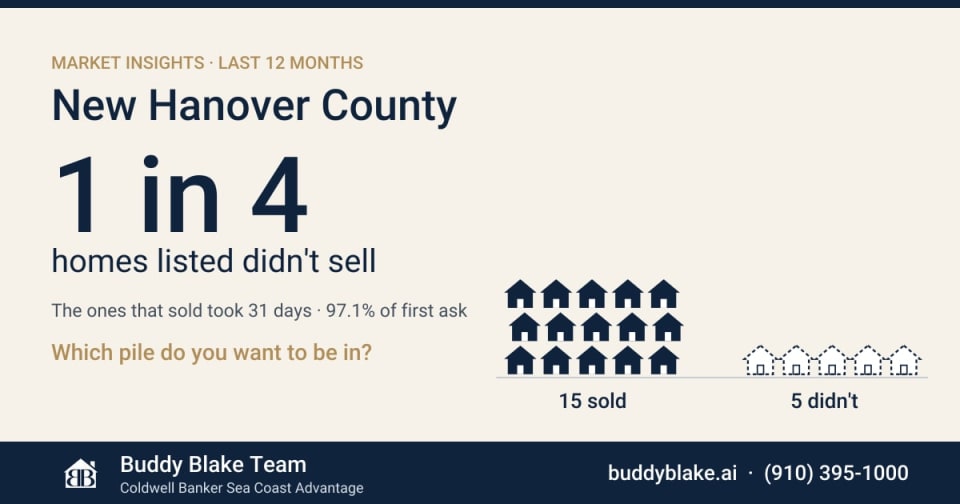
Over the last 12 months, 1 in 4 homes that came off the market in New Hanover County didn't sell. That's 1,446 of 5,598 homes, or 26%, up from 23% the year before. By "didn't sell," I mean the listing expired, was withdrawn or was canceled.
New Hanover County by the numbers
| Homes that finished on the market (12 months) | 5,598 |
| Sold | 4,152 |
| Didn't sell (expired, withdrawn or canceled) | 1,446 (26%) |
| Typical days to sell, from first listed | 31 days |
| Sold vs. first asking price | 97.1% |
| Priced right from day one: typical days to sell | 10 days |
| Needed price cuts: typical days to sell | 70 days |
| Contracts that fell apart before closing | 16% |
| Monthly taxes, insurance, upkeep and utilities on a typical home (before any mortgage) | $1,007 |
Source: Hive MLS data compiled by the Buddy Blake Team, last 12 months. See the full New Hanover County report or download the printable PDF there.
Why homes don't sell here
The homes that sold took a typical 31 days, at a median sold price of $470,000. So the market is moving. The question is which homes are moving and which are sitting.
Price range matters. The $1M+ range had the highest rate of homes that didn't sell, at 33%. The $300–400K range had the lowest, at 21%. Even the best range still has about 1 in 5 homes leaving the market unsold.
The clearest split I see in the report is what happens when a home is priced right from day one:
- Priced right from the start: 2,138 homes, with a typical 10 days to sell.
- Needed price cuts: 2,014 homes, with a typical 70 days to sell, and they sold at a median 93.0% of asking.
The homes that never sold tell the same story. They sat a median 130 days, and their median price cut was only 2.1%. That's a small move after a long wait.
Here's the part that surprises people. Homes that sold went for a median 97.1% of their first asking price, and 71% of them sold below that first ask. Most sellers end up negotiating. The ones who start at a price buyers accept don't spend months learning that lesson one small cut at a time.
What waiting costs
Every extra week on the market is a week of bills. The report uses a $470,000 home as its example. Carrying it costs $1,007 a month before the mortgage. The report puts the carrying cost while a home sits unsold at $4,324 before the mortgage.
That's money going out on a house that isn't moving you toward your next step. It also doesn't count the stress of showing a home for months. I've seen what a long wait does to a family's plans, and it's the reason I bring up pricing first and not last. If you're weighing whether to rent a home out after it doesn't sell, I wrote about that in The Rent to Survive Report.
Why contracts fall apart, and how to prepare
A signed contract isn't a sold home. In the last 12 months, 16% of contracts fell apart, about 1 in 6.
The numbers on what happens next are worth knowing:
- Homes whose first contract held took a typical 25 days to sell and got a median 97.5% of asking.
- Homes that sold after a contract fell apart went for a median 94.1% of asking.
- After a contract fell apart, 62% of those homes later sold and 36% never did.
The MLS doesn't record why contracts fall apart. From my own experience, it's most often inspection, appraisal or financing. That's general experience, not a number from the report.
The good news is that you can get ahead of the first two. Knowing what an inspector will find before a buyer's inspector finds it takes away a lot of surprises. I walk through the options in Before You List on the NC Coast: Inspect, Repair or Sell As-Is? If you want the longer version, our Deal Killer Report covers how a pre-inspection helps keep a sale alive. You can also see how my team sells homes, including the pre-market inspection.
What it means for buyers
If you're buying, these numbers cut in your favor in places and against you in others.
First, there's room to talk. With 71% of sold homes going for less than the first ask, and a median of 97.1% of that first price, a list price is a starting point and not a final answer. A home that has sat a while, like those 130-day listings, may be a different conversation than one that just hit the market.
Second, know how you'll pay. Of buyers in the report, 27% paid cash, 58% used conventional loans, 5% used VA and 5% used FHA. A clean, well-supported financing plan helps you stand out whichever way you go. Since appraisal and financing are among the most common reasons a contract fails, a solid lender and a clear plan protect you too.
Third, be careful with a home that already had a contract fall apart. Some of those homes were fine and some had issues. Ask good questions and get your own inspection.
When you're ready to look, start with homes for sale in New Hanover County, and see how our team helps buyers.
These are the numbers behind the daily decisions I help sellers make. You can read the full breakdown in the New Hanover County Market Insights report. If you have a home to sell, or a question about any of this, call or text me at (910) 395-1000. We can do hard things, and a good plan makes them easier.
Read the episode transcript
Host: Today we're getting right into Did You Know? One in four New Hanover County homes didn't sell. Buddy Blake is here to walk us through it. Buddy, welcome back to Real Stories. I saw that number and did a double take. One in four?
Buddy Blake: Yeah, thanks for having me. And it's real. Over the last twelve months, five thousand five hundred ninety-eight homes came off the market in New Hanover County. One thousand four hundred forty-six of those didn't sell. That's twenty-six percent. The year before it was twenty-three percent, so it's moving the wrong direction.
Host: Okay, so when you say 'didn't sell,' what do you actually mean? Because I think people hear that and picture, I don't know, a deal blowing up.
Buddy Blake: Good question, and I want to be clear on it. By 'didn't sell' I mean the listing expired, got withdrawn, or got canceled. That's it. The home came off the market without a sale. A deal falling apart after a contract is a different thing, and we'll get to that, because it's its own problem.
Host: Got it. So the market isn't dead, then. Homes are selling.
Buddy Blake: Right, exactly. Four thousand one hundred fifty-two of those homes sold. The ones that sold took a typical thirty-one days, at a median sold price of four hundred seventy thousand dollars. So the market is moving. The real question is which homes are moving and which ones are sitting.
Host: Okay, so which ones are sitting? Is it a price range thing?
Buddy Blake: Price range matters, yeah. The one million dollar and up range had the highest rate of homes that didn't sell, thirty-three percent. The three hundred to four hundred thousand range had the lowest, at twenty-one percent. But notice that even the best range still has about one in five homes leaving the market unsold. So nobody's totally safe.
Host: Huh. So what's the biggest dividing line you're seeing in the report?
Buddy Blake: Honestly, it's pricing from day one. Two thousand one hundred thirty-eight homes were priced right from the start, and those took a typical ten days to sell. Ten days. Then you've got two thousand and fourteen homes that needed price cuts. Those took a typical seventy days, and they sold at a median of ninety-three percent of asking.
Host: Wow. Ten days versus seventy. That's not even close.
Buddy Blake: Not even close. And the homes that never sold tell the same story. They sat a median of one hundred thirty days, and their median price cut was only two point one percent. That's a small move after a very long wait.
Host: Oof. So they waited all that time and then barely moved the price.
Buddy Blake: Yep. And here's the part that surprises people. Homes that sold went for a median of ninety-seven point one percent of their first asking price, and seventy-one percent of them sold below that first ask. So most sellers end up negotiating anyway. The ones who start at a price buyers accept don't spend months learning that lesson one small cut at a time.
Host: That makes so much sense. Okay, let's talk about what waiting actually costs, because I feel like people don't always think about that.
Buddy Blake: They really don't. Every extra week on the market is a week of bills. The report uses a four hundred seventy thousand dollar home as its example. Carrying that home, meaning taxes, insurance, upkeep and utilities, runs one thousand seven dollars a month, and that's before any mortgage. And the report puts the carrying cost while a home sits unsold at four thousand three hundred twenty-four dollars, again before the mortgage.
Host: And that's money going out on a place that isn't getting you anywhere.
Buddy Blake: Right. It's not moving you toward your next step. And it doesn't even count the stress of showing a home for months. I've seen what a long wait does to a family's plans, and that's why I bring up pricing first and not last. If you're weighing whether to rent a home out after it doesn't sell, I wrote about that in The Rent to Survive Report. It's linked in the show notes.
Host: Okay, so let's say a home does get a buyer. Signed contract, high fives. Is that it?
Buddy Blake: Not quite. A signed contract isn't a sold home. In the last twelve months, sixteen percent of contracts fell apart, about one in six. And the numbers on what happens next are worth knowing.
Host: Okay, hit me with them.
Buddy Blake: Homes whose first contract held took a typical twenty-five days to sell and got a median of ninety-seven point five percent of asking. Homes that sold after a contract fell apart went for a median of ninety-four point one percent. And after a contract fell apart, sixty-two percent of those homes later sold, and thirty-six percent never did.
Host: So a fallen contract really costs you. Do we know why they fall apart?
Buddy Blake: The MLS doesn't record why, so I can't give you a number on that. From my own experience, it's most often inspection, appraisal or financing. But that's general experience, not a number from the report. The good news is you can get ahead of the first two.
Host: How so?
Buddy Blake: Know what an inspector is going to find before the buyer's inspector finds it. That takes away a lot of surprises. I walk through the options in Before You List on the NC Coast: Inspect, Repair or Sell As-Is? And if you want the longer version, our Deal Killer Report covers how a pre-inspection helps keep a sale alive. Both are in the show notes. My team also does a pre-market inspection when we sell homes.
Host: I love that. Okay, flip it around for me. If someone's listening and they're a buyer, what do these numbers mean for them?
Buddy Blake: They cut in your favor in some places and against you in others. First, there's room to talk. With seventy-one percent of sold homes going for less than the first ask, and a median of ninety-seven point one percent of that first price, a list price is a starting point, not a final answer. And a home that's sat a while, like those hundred-thirty-day listings, may be a different conversation than one that just hit the market.
Host: Right, that makes sense. What else?
Buddy Blake: Second, know how you'll pay. Of the buyers in the report, twenty-seven percent paid cash, fifty-eight percent used conventional loans, five percent used VA and five percent used FHA. A clean, well-supported financing plan helps you stand out whichever way you go. Since appraisal and financing are among the most common reasons a contract fails, a solid lender and a clear plan protect you too.
Host: And the third thing?
Buddy Blake: Be careful with a home that already had a contract fall apart. Some of those homes were fine, and some had issues. So ask good questions and get your own inspection. When you're ready to look, start with homes for sale in New Hanover County. And my team has buyer specialists who can help you. Both links are in the show notes.
Host: This was really eye-opening, Buddy. Twenty-six percent is a big number, and the gap between ten days and seventy days sticks with me. Where can people reach you if they want to dig in?
Buddy Blake: Thanks, I appreciate it. These are the numbers behind the daily decisions I help sellers make. If you have a home to sell, or a question about any of this, call or text me at nine one zero, three nine five, one thousand. The full article, with the whole New Hanover County Market Insights breakdown, is linked in the show notes. We can do hard things, and a good plan makes them easier.